

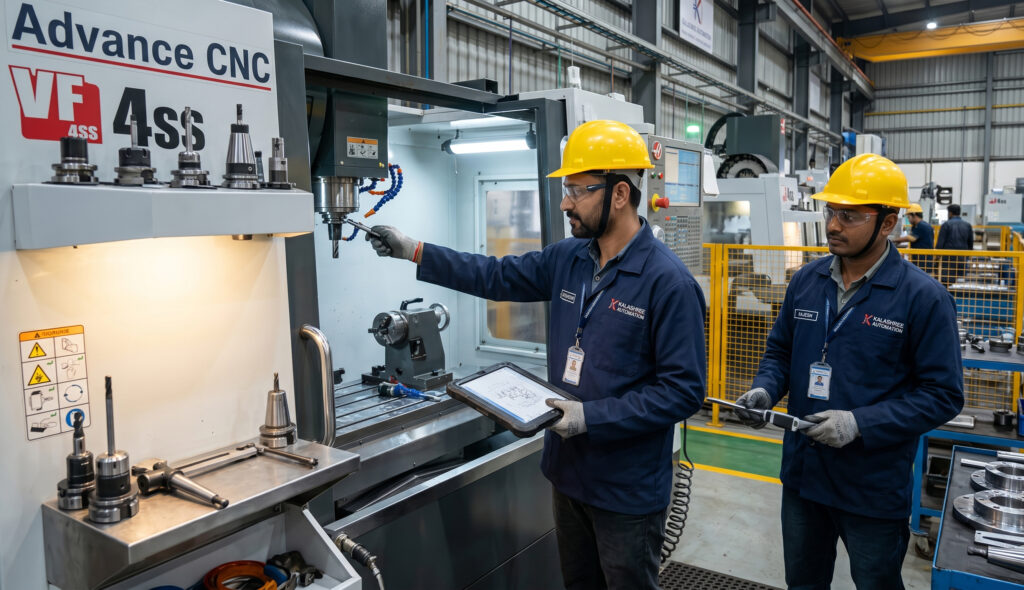
In the competitive industrial clusters of Pune and PCMC, running a CNC machine is a feat of engineering physics. At Kalashree Automation, we believe that understanding why a machine fails is the first step toward 100% uptime.
For the shop floor managers and technical leads in MIDC, here is a deep dive into the technical variables that determine the life of your Fanuc and Siemens-controlled machinery.
In the industrial hubs of Pune, Chakan, and Pimpri-Chinchwad, the difference between a profitable quarter and a stressful one often comes down to a single factor: Machine Availability.
1. The Battle Against Backlash ($B$)
Backlash is the “play” or lost motion in a mechanism caused by gaps between the parts (like the ballscrew and the nut). In precision machining, backlash is the enemy of circularity and surface finish.
- The Technical Formula: If $L$ is the commanded distance and $L_a$ is the actual distance moved, the backlash is $B = L – L_a$.
- The Solution: While modern Fanuc and Siemens controllers allow for Software Backlash Compensation, there is a physical limit. If your backlash exceeds 0.05 mm, software “tricks” cannot hide the mechanical wear. Our team performs physical adjustments to the ballscrew mounting and nut preloads to restore structural rigidity.
2. Servo Loop Tuning: The Ghost in the Machine
Ever wonder why your machine vibrates or “hunts” for a position? This is often a matter of Servo Gain Tuning.
- The Physics: Your controller (Fanuc/Siemens) constantly monitors the difference between the commanded position and the actual position (the “Following Error”).
- The Conflict: If the gain is too high, the motor over-reacts and oscillates. If it’s too low, the machine becomes sluggish and loses accuracy during high-speed transitions.
- Kalashree Expertise: We fine-tune the velocity and current loops of your Fanuc Alpha Series or Siemens SINAMICS drives to ensure the machine remains “tight” without inducing harmonic vibrations.
3. Thermal Displacement & Spindle Runout
A spindle rotating at 10,000 RPM is subject to centrifugal forces and thermal expansion.
- Total Indicated Runout (TIR): Even a few microns of runout can cause premature tool wear. We use precision test bars to measure TIR at both the gauge line and at a 150mm extension.
- Thermal Growth: In the intense afternoon heat of Chakan and Bhosari, machine castings expand. A standard CNC can shift by 10–30 microns just from temperature changes. Our maintenance includes checking the cooling flow and ensuring the thermal compensation parameters in your CNC are correctly calibrated to the Pune climate.
4. The “Hidden” Electronics Hygiene
In the MIDC area, the air is often laden with fine metallic dust and oil mist.
- The Hazard: These particles settle on the high-voltage IGBT modules of your servo drives.
- The Result: A “High Current” or “Ground Fault” alarm ($ALM 414$ on Fanuc or $F30001$ on Siemens).
- Our Preventive Protocol: During an AMC visit, we don’t just “wipe the machine.” We perform a deep-clean of the heat sinks and cooling fans within the control cabinet, ensuring that the critical power electronics stay within their safe operating temperature (typically $< 55^\circ C$).
Technical Support for a Technical Industry
At Kalashree Automation, we don’t just clear alarms; we optimize the system. Whether it’s replacing a worn pulse coder cable or re-leveling a multi-ton machining center, we bring an engineering-first approach to the Pune industrial belt.
Upgrade your maintenance from “Repair” to “Engineering Excellence” today..
Kalashree Automation
Precision Maintenance for Fanuc & Siemens Systems
Serving Pimpri-Chinchwad, Bhosari, Chakan, and Talawade.